
The gap between Nifty's price-earnings multiple and economic growth is at a 12-year high

Profit taking in index heavweights RIL and HDFC weighed on sentiment while ICICI Bank surged 7%.

Asset sales have helped ease investors' worry but debt remains at alarming levels

In the first eight months of 2019, 70 per cent stocks in the BSE 500 universe were down. These stocks account for 94 per cent of India's total market capitalisation.

A strengthening dollar, rising interest rates, tightening liquidity and a surge in oil prices - all are combining to create a toxic atmosphere for EM assets, says Akash Prakash.

According to experts, due to reduction in withholding tax, FIIs' investment in corporate bonds will pick up.

SBI is the first major state-run bank to hike lending rates after short-term rates rose as a result of the Reserve Bank of India's liquidity tightening moves announced in July.

Other than ITC, other laggards include PowerGrid, Infosys, M&M, NTPC, SBI, HDFC, Kotak Bank, HDFC Bank, TCS, Hero MotoCorp, Coal India, ONGC, RIL, Asian Paint, IndusInd Bank, ICICI Bank, Maruti Suzuki, Bajaj Auto, Tata Motors, Bharti Airtel and Axis Bank.

Banks have not cut rates yet as March is typically a busy season.

'The financial sector will be hit even harder than the overall market.' 'The banking sector will eventually be rescued.' 'But it may go into a long downwards spiral before things turn around.' 'Threat or buying opportunity?' asks Devangshu Datta.

'Long-term retail investors should not worry about these sharp dips and jumps if they have chosen their stocks wisely.' 'Short-term volatility is a given and a rise and fall of two-three per cent should not worry them.'

After another day of volatile trade, the rupee today appreciated by seven paise to close at a new one-month high of 59.04 against the dollar as the RBI's liquidity-tightening measures continued to lend support.

Promoters of SpiceJet do not have funds to bail out the airlines of dire consequences.

The list covers companies with annual revenue of $5 mn to $1 bn.

Liquidity, stable income generation, potential capital appreciation are the benefits from REITs

The Survey also said that the borrowings by banks have increased significantly.

Axis Bank emerged as the biggest gainer in the Sensex pack, surging 6.62 per cent, followed by SBI at 5.88 per cent.

RBI has printed 16,957 million pieces of Rs 500 notes and 3,654 million pieces of Rs 2,000 notes as on December 8.

Major losers include Lupin 1.96 per cent, along with Tata Motors, Coal India and Sun Pharma.

Crude oil prices have more than doubled, pushing up India's import bill and raising fears of a higher current account and fiscal deficit. This will impact corporate earnings.

Sun Pharma was the biggest loser among Sensex components, plunging 3.94 per cent, followed by Tata Steel falling 3.12 per cent.

Markets ended weak tracking the expiry of April derivative contracts.

The MSME sector, which is employment-intensive, accounts for 45 per cent of the country's manufacturing, 40 per cent of exports and nearly 8 per cent of gross domestic product.

Rebound in IT majors TCS and Infosys in late trades helped markets end higher.

Listed Mumbai developers are battling higher inventory levels.

New filers reported an average income, in many cases, close to the income tax threshold of Rs 250,000, limiting the early revenue impact.

market rally, especially in mid-caps, has also been driven by a pick-up in the monsoon and the government's resolve to get the goods and services tax (GST) Bill cleared in the recent session of Parliament.

The government's total debt increased by 2.6 per cent to over Rs 46 lakh crore in the third quarter ended December, compared to the previous three months of the current financial year.

'Willing to spend is different from when to spend and how much to spend'

Assume that the rupee will trend lower over the next 10 years as India increases overseas sovereign exposures, and your long-term asset allocation should be geared to deal with this trend, suggests Devangshu Datta

The BSE Realty Index is on a downhill journey.

Why the case for investing in passive funds is becoming stronger.

The indices closed with losses for the week, with the Sensex declining 476.14 points, and the broader NSE Nifty falling 155.45 points during the period.

Reserve Bank is scheduled to announce its bi-monthly monetary policy on August 3.

In the Sensex kitty, ITC turned star performer by surging 2.45 per cent, followed by NTPC rising 2.19 per cent.

Though Indian banks don't have large exposure to subprime mortgages, analysts are worried at the rise in their restructured loan portfolios and deterioration in credit quality.
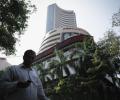
Risk sentiment received a boost after eight core sectors grew to a five-month high of 4.9 per cent in August

Beware: During the period that you avail of the moratorium, there would be no repayment of interest or principal. Thus, the outstanding will go up substantially for this period as a consequence

'If the government spends Rs 10 lakh crore this year then you would be looking at a GDP growth of minus 5 per cent.' 'If you do not do this, you will be looking at GDP growth between minus nine and minus 10 per cent.'

These investors have pumped in about Rs 6,900 crore (Rs 69 billion) in the seven trading sessions after the Federal Open Market Commission meet.
